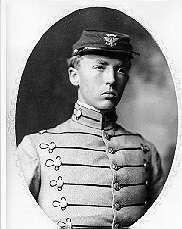
George Smith Patton,
III
General and Churchman
[December 9th]
Almighty and most merciful
Father, we humbly beseech Thee, of Thy great goodness, to restrain
these immoderate rains with which we have had to contend. Grant us
fair weather for Battle. Graciously hearken to us as soldiers who
call upon Thee that, armed with Thy power, we may advance from
victory to victory, and crush the oppression and wickedness of our
enemies and establish Thy justice among men and
nations. Amen
[Collect issued by order of the Commanding General,
December 1944, Third US Army, France. See the Chaplain's account
at the bottom]
"It is foolish and wrong to mourn the men who died.
Rather we should thank God that such men lived."

Patton Window & St George
Does God still train up faithful
warriors? In Psalm 144 we hear David say,
"Blessed be the LORD my strength, which teacheth my hands to
war and my fingers to fight... "
David, whose heart was right with God, sings praises to his
heavenly Father and credits Almighty God for his vitality and
amazing success in battle. In addition, the bible recounts David's
many mighty men that God gave him
according to the word of the Lord. Has God in his providence raised
up mighty warriors in our time? Today, let us consider one of the
most famous warriors of modern times" General George S. Patton,
Commander of the US Third Army.
George Stroop wrote, "Patton, known throughout his life as
"Georgie" was born Nov 11, 1885 in San Gabriel, CA, to George Smith
Patton Jr, and Ruth Wilson. "Georgie spent his childhood listening
to stories of military heroes. Both his father and grandfather,
Col. George S. Patton, had attended Virginia Military Institute
(VMI), where Patton's favorite hero, Thomas "Stonewall" Jackson had taught.
The elder Patton had been a colonel in the Confederacy in the War
Between the States, and had been killed at the front of his
brigade, the 22nd Virginia Infantry, at the Battle of Cedar Creek
in 1864. Actually, George Jr. had no less than 7 uncles that fought
for the Confederacy. Various Confederate heroes had befriended the
family after the war, namely John Singleton Mosby, the partisan
cavalry leader. Patton had sat on Mosby's knee, listening to
stories of daring and heroism by Mosby, and Mosby's close friend,
General J.E.B. Stuart...Father and son made many trips to Virginia,
visiting Civil War battlefields.... Patton was educated by his
father, an influential attorney, in classical literature and
history, notably the Iliad, Macaulay's Laws of Ancient Rome, and
Kipling. He knew most of the Bible by heart before he could
read."
Patton entered VMI and subsequently received an appointment to
West Point. Upon graduation he served as Aide de Camp to General
Pershing in 1916 in Mexico, and in WWI as a Captain commanding
Pershing's Headquarters Company. He was then promoted to Major and
given command of a tank unit.
In World War Two Patton, who was the Army's foremost authority on
Tank Warfare, served in a series of commands in Africa, Sicily, and
then in Europe, finally as the commander of the Third Army. During
the Battle of the Bulge, when Allied forces were tied up with
unfavorable weather, he concluded that the only thing that could
help was relief from God, and that the troops needed to enter
prayer in earnest. He directed his chaplain to
write the prayer, which opened this Lesson, for favorable weather
and victory. He issued 250,000 copies of it to his Army... and his
men prayed. I believe God answered that prayer. The weather
cleared, the ground froze solid, and Patton quickly moved his
armored columns to relieve the 101st Airborne Division encircled at
Bastogne, France, and broke the German's offensive... the last of
the war (to the somewhat amazement not only of the Germans, but
also to the allies). He and the Third went on to distinguish
themselves in every engagement.
Stroop wrote, "Though belied by his rough language, peppered
generously with four-letter expletives, Patton was an extremely
religious man. He prayed in earnest every morning, night, and
anytime that he felt he needed divine assistance in his performance
or making decisions. For a time, Beatrice [his wife], though also
receiving a Christian upbringing, really didn't understand George's
constant praying. Once, before a polo match, she found Patton in
the bedroom, polo mallet and helmet laying on the bed, on his knees
praying. When he stood up, she asked him if he was praying for
victory. Patton exclaimed, "Hell no, I'm praying that I do my
best." Knowing that Patton felt that performing your best was
always the most important thing, she then understood"
His chaplain wrote of him, "He had no use for half-measures. He
wrote this line a few days before his death: 'Anyone in any walk of
life who is content with mediocrity is untrue to himself and to
American tradition.' He was true to the principles of his religion,
Episcopalian, and was regular in Church attendance and practices,
unless duty made his presence impossible."
After hostilities ended, General Patton, commanding the 15th Army
of Occupation, was involved in a automobile crash on 9 December,
almost a year to the day after he directed his chaplain to write
the prayer. He died of complications on 21 December, nearly one
year from the day the skies cleared and the allied bombers were
able to attack.
General Patton now rests in peace in Luxemburg, along with
30,000 of his troops who fought with him in the Battle of the
Bulge.
History now accords to General Patton a place among America's
greatest generals: I now ask you to consider: "Did God in his
providence raise up George S. Patton III, to follow in the steps of
his ancestors who fought in the Revolutionary, the Mexican
American, and the War Between the States, to be part of the winning
team that crushed the evil of the Axis powers in World War II? I
believe so, but then I believe that God in his omnipotence and
omniscience has all things in his hands, and all things work for
Good according to God's purposes. One day we shall know.
I have fought a good fight, I have
finished my course, I have kept the faith.
The True Story of The Patton Prayer by Msgr. James H. O'Neill
(From the Review of the News 6 October 1971)
[NOTE: THIS DOCUMENT IS IN THE PUBLIC
DOMAIN AS IT WAS ORGINALLY PUBLISHED IN A US GOVERNMENT
DOCUMENT]
Many
conflicting and some untrue stories have been printed about General
George S. Patton and the Third Army Prayer. Some have had the tinge
of blasphemy and disrespect for the Deity. Even in "War As I Knew
It" by General Patton, the footnote on the Prayer by Colonel Paul
D. Harkins, Patton's Deputy Chief of Staff, while containing the
elements of a funny story about the General and his Chaplain, is
not the true account of the prayer Incident or its
sequence.
As the
Chief Chaplain of the Third Army throughout the five campaigns on
the Staff of General Patton, I should have some knowledge of the
event because at the direction of General Patton I composed the now
world famous Prayer, and wrote Training Letter No. 5, which
constitutes an integral, but untold part, of the prayer story.
These Incidents, narrated in sequence, should serve to enhance the
memory of the man himself, and cause him to be enshrined by
generations to come as one of the greatest of our soldiers. He had
all the traits of military leadership, fortified by genuine trust
in God, intense love of country, and high faith In the American
soldier.
He had no
use for half-measures. He wrote this line a few days before his
death: "Anyone in any walk of life who is content with mediocrity
is untrue to himself and to American tradition." He was true to the
principles of his religion, Episcopalian, and was regular in Church
attendance and practices, unless duty made his presence
Impossible.
The
incident of the now famous Patton Prayer commenced with a telephone
call to the Third Army Chaplain on the morning of December 8, 1944,
when the Third Army Headquarters were located in the Caserne
Molifor in Nancy, France: "This is General Patton; do you have a
good prayer for weather? We must do something about those rains if
we are to win the war." My reply was that I know where to look for
such a prayer, that I would locate, and report within the hour. As
I hung up the telephone receiver, about eleven in the morning, I
looked out on the steadily falling rain, "immoderate" I would call
it -- the same rain that had plagued Patton's Army throughout the
Moselle and Saar Campaigns from September until now, December 8.
The few prayer books at hand contained no formal prayer on weather
that might prove acceptable to the Army Commander. Keeping his
immediate objective in mind, I typed an original and an improved
copy on a 5" x 3" filing card:
Almighty
and most merciful Father, we humbly beseech Thee, of Thy great
goodness, to restrain these immoderate rains with which we have had
to contend. Grant us fair weather for Battle. Graciously hearken to
us as soldiers who call upon Thee that, armed with Thy power, we
may advance from victory to victory, and crush the oppression and
wickedness of our enemies and establish Thy justice among men and
nations.
I pondered
the question, What use would General Patton make of the prayer?
Surely not for private devotion. If he intended it for circulation
to chaplains or others, with Christmas not far removed, it might he
proper to type the Army Commander's Christmas Greetings on the
reverse side. This would please the recipient, and anything that
pleased the men I knew would please him:
To each
officer and soldier in the Third United States Army, I Wish a Merry
Christmas. I have full confidence in your courage, devotion to
duty, and skill in battle. We march in our might to complete
victory. May God's blessings rest upon each of you on this
Christmas Day. G.S. Patton, Jr, Lieutenant General, Commanding,
Third United States Army.
This done,
I donned my heavy trench coat, crossed the quadrangle of the old
French military barracks, and reported to General Patton. He read
the prayer copy, returned it to me with a very casual directive,
"Have 250,000 copies printed and see to it that every man in the
Third Army gets one." The size of the order amazed me; this was
certainly doing something about the weather in a big way. But I
said nothing but the usual, "Very well, Sir!" Recovering, I invited
his attention to the reverse side containing the Christmas
Greeting, with his name and rank typed. "Very good," he said, with
a smile of approval. "If the General would sign the card, it would
add a personal touch that I am sure the men would like." He took
his place at his desk, signed the card, returned it to me and then
Said: "Chaplain, sit down for a moment; I want to talk to you about
this business of prayer." He rubbed his face in his hands, was
silent for a moment, then rose and walked over to the high window,
and stood there with his back toward me as he looked out on the
falling rain. As usual, he was dressed stunningly, and his
six-foot-two powerfully built physique made an unforgettable
silhouette against the great window. The General Patton I saw there
was the Army Commander to whom the welfare of the men under him was
a matter of Personal responsibility . Even in the heat of combat he
could take time out to direct new methods to prevent trench feet,
to see to it that dry socks went forward daily with the rations to
troops on the line, to kneel in the mud administering morphine and
caring for a wounded soldier until the ambulance Came. What was
coming now?
"Chaplain,
how much praying is being done in the Third Army?" was his
question. I parried: "Does the General mean by chaplains, or by the
men?" "By everybody," he replied. To this I countered: "I am afraid
to admit it, but I do not believe that much praying is going on.
When there Is fighting, everyone prays, but now with this constant
rain -- when things are quiet, dangerously quiet, men just sit and
wait for things to happen. Prayer out here is difficult. Both
chaplains and men are removed from a special building with a
steeple. Prayer to most of them is a formal, ritualized affair,
involving special posture and a liturgical setting. I do not
believe that much praying is being done."
The General
left the window, and again seated himself at his desk, leaned back
in his swivel chair, toying with a long lead pencil between his
index fingers.
Chaplain, I
am a strong believer in Prayer. There are three ways that men get
what they want; by planning, by working, and by Praying. Any great
military operation takes careful planning, or thinking. Then you
must have well-trained troops to carry it out: that's working. But
between the plan and the operation there is always an unknown. That
unknown spells defeat or victory, success or failure. It is the
reaction of the actors to the ordeal when it actually comes. Some
people call that getting the breaks; I call it God. God has His
part, or margin in everything, That's where prayer comes in. Up to
now, in the Third Army, God has been very good to us. We have never
retreated; we have suffered no defeats, no famine, no epidemics.
This is because a lot of people back home are praying for us. We
were lucky in Africa, in Sicily, and in Italy. Simply because
people prayed. But we have to pray for ourselves, too. A good
soldier is not made merely by making him think and work. There is
something in every soldier that goes deeper than thinking or
working--it' s his "guts." It is something that he has built in
there: it is a world of truth and power that is higher than
himself. Great living is not all output of thought and work. A man
has to have intake as well. I don't know what you it, but I call it
Religion, Prayer, or God.
He talked
about Gideon in the Bible, said that men should pray no matter
where they were, in church or out of it, that if they did not pray,
sooner or later they would "crack up." To all this I commented
agreement, that one of the major training objectives of my office
was to help soldiers recover and make their lives effective in this
third realm, prayer. It would do no harm to re-impress this
training on chaplains. We had about 486 chaplains in the Third Army
at that time, representing 32 denominations. Once the Third Army
had become operational, my mode of contact with the chaplains had
been chiefly through Training Letters issued from time to time to
the Chaplains in the four corps and the 22 to 26 divisions
comprising the Third Army. Each treated of a variety of subjects of
corrective or training value to a chaplain working with troops in
the field. [Patton continued:]
I wish you
would put out a Training Letter on this subject of Prayer to all
the chaplains; write about nothing else, just the importance of
prayer. Let me see it before you send it. We've got to get not only
the chaplains but every man in the Third Army to pray. We must ask
God to stop these rains. These rains are that margin that hold
defeat or victory. If we all pray, it will be like what Dr. Carrel
said [the allusion was to a press quote some days previously when
Dr. Alexis Carrel, one of the foremost scientists, described prayer
"as one of the most powerful forms of energy man can generate"], it
will be like plugging in on a current whose source is in Heaven. I
believe that prayer completes that circuit. It is
power.
With that
the General arose from his chair, a sign that the interview was
ended. I returned to my field desk, typed Training Letter No. 5
while the "copy" was "hot," touching on some or all of the
General's reverie on Prayer, and after staff processing, presented
it to General Patton on the next day. The General read it and
without change directed that it be circulated not only to the 486
chaplains, but to every organization commander down to and
including the regimental level. Three thousand two hundred copies
were distributed to every unit in the Third Army over my signature
as Third Army Chaplain. Strictly speaking, it was the Army
Commander's letter, not mine. Due to the fact that the order came
directly from General Patton, distribution was completed on
December 11 and 12 in advance of its date line, December 14, 1944.
Titled "Training Letter No. 5," with the salutary "Chaplains of the
Third Army," the letter continued: "At this stage of the operations
I would call upon the chaplains and the men of the Third United
States Army to focus their attention on the importance of
prayer.
"Our
glorious march from the Normandy Beach across France to where we
stand, before and beyond the Siegfried Line, with the wreckage of
the German Army behind us should convince the most skeptical
soldier that God has ridden with our banner. Pestilence and famine
have not touched us. We have continued in unity of purpose. We have
had no quitters; and our leadership has been masterful. The Third
Army has no roster of Retreats. None of Defeats. We have no memory
of a lost battle to hand on to our children from this great
campaign.
"But we are
not stopping at the Siegfried Line. Tough days may be ahead of us
before we eat our rations in the Chancellery of the Deutsches
Reich.
"As
chaplains it is our business to pray. We preach its importance. We
urge its practice. But the time is now to intensify our faith in
prayer, not alone with ourselves, but with every believing man,
Protestant, Catholic, Jew, or Christian in the ranks of the Third
United States Army.
"Those who
pray do more for the world than those who fight; and if the world
goes from bad to worse, it is because there are more battles than
prayers. 'Hands lifted up,' said Bosuet, 'smash more battalions
than hands that strike.' Gideon of Bible fame was least in his
father's house. He came from Israel's smallest tribe. But he was a
mighty man of valor. His strength lay not in his military might,
but in his recognition of God's proper claims upon his life. He
reduced his Army from thirty-two thousand to three hundred men lest
the people of Israel would think that their valor had saved them.
We have no intention to reduce our vast striking force. But we must
urge, instruct, and indoctrinate every fighting man to pray as well
as fight. In Gideon's day, and in our own, spiritually alert
minorities carry the burdens and bring the
victories.
"Urge all
of your men to pray, not alone in church, but everywhere. Pray when
driving. Pray when fighting. Pray alone. Pray with others. Pray by
night and pray by day. Pray for the cessation of immoderate rains,
for good weather for Battle. Pray for the defeat of our wicked
enemy whose banner is injustice and whose good is oppression. Pray
for victory. Pray for our Army, and Pray for
Peace.
"We must
march together, all out for God. The soldier who 'cracks up' does
not need sympathy or comfort as much as he needs strength. We are
not trying to make the best of these days. It is our job to make
the most of them. Now is not the time to follow God from 'afar
off.' This Army needs the assurance and the faith that God is with
us. With prayer, we cannot fail.
"Be assured
that this message on prayer has the approval, the encouragement,
and the enthusiastic support of the Third United States Army
Commander.
"With every
good wish to each of you for a very Happy Christmas, and my
personal congratulations for your splendid and courageous work
since landing on the beach, I am," etc., etc., signed The Third
Army Commander.
The timing
of the Prayer story is important: let us rearrange the dates: the
"Prayer Conference" with General Patton was 8 December; the 664th
Engineer Topographical Company, at the order of Colonel David H.
Tulley, C.E., Assistant to the Third Army Engineer, working night
and day reproduced 250,000 copies of the Prayer Card; the Adjutant
General, Colonel Robert S. Cummings, supervised the distribution of
both the Prayer Cards and Training Letter No. 5 to reach the troops
by December 12-14. The breakthrough was on December 16 in the First
Army Zone when the Germans crept out of the Schnee Eifel Forest in
the midst of heavy rains, thick fogs, and swirling ground mists
that muffled sound, blotted out the sun, and reduced visibility to
a few yards. The few divisions on the Luxembourg frontier were
surprised and brushed aside. They found it hard to fight an enemy
they could neither see nor hear. For three days it looked to the
jubilant Nazis as if their desperate gamble would succeed. They had
achieved compete surprise. Their Sixth Panzer Army, rejuvenated in
secret after its debacle in France, seared through the Ardennes
like a hot knife through butter. The First Army's VIII Corps was
holding this area with three infantry divisions (one of them new
and in the line only a few days) thinly disposed over an 88-mile
front and with one armored division far to the rear, in reserve.
The VIII Corps had been in the sector for months. It was considered
a semi-rest area and outside of a little patrolling was wholly an
inactive position.
When the
blow struck the VIII Corps fought with imperishable heroism. The
Germans were slowed down but the Corps was too shattered to stop
them with its remnants. Meanwhile, to the north, the Fifth Panzer
Army was slugging through another powerful prong along the
vulnerable boundary between the VIII and VI Corps. Had the bad
weather continued there is no telling how far the Germans might
have advanced. On the 19th of December, the Third Army turned from
East to North to meet the attack. As General Patton rushed his
divisions north from the Saar Valley to the relief of the
beleaguered Bastogne, the prayer was answered. On December 20, to
the consternation of the Germans and the delight of the American
forecasters who were equally surprised at the turn-about-the rains
and the fogs ceased. For the better part of a week came bright
clear skies and perfect flying weather. Our planes came over by
tens, hundreds, and thousands. They knocked out hundreds of tanks,
killed thousands of enemy troops in the Bastogne salient, and
harried the enemy as he valiantly tried to bring up reinforcements.
The 101st Airborne, with the 4th, 9th, and 10th Armored Divisions,
which saved Bastogne, and other divisions which assisted so
valiantly in driving the Germans home, will testify to the great
support rendered by our air forces. General Patton prayed for fair
weather for Battle. He got it.
It was late
in January of 1945 when I saw the Army Commander again. This was in
the city of Luxembourg. He stood directly in front of me, smiled:
"Well, Padre, our prayers worked. I knew they would." Then he
cracked me on the side of my steel helmet with his riding crop.
That was his way of saying, "Well done."
(This
article appeared as a government document in 1950. At the time it
appeared in the Review of the News, Msgr. O'Neill was a retired
Brigadier General living in Pueblo, Colorado.)
Copyright. Order of Centurions. Reviewed 8:27 AM 1/22/2014